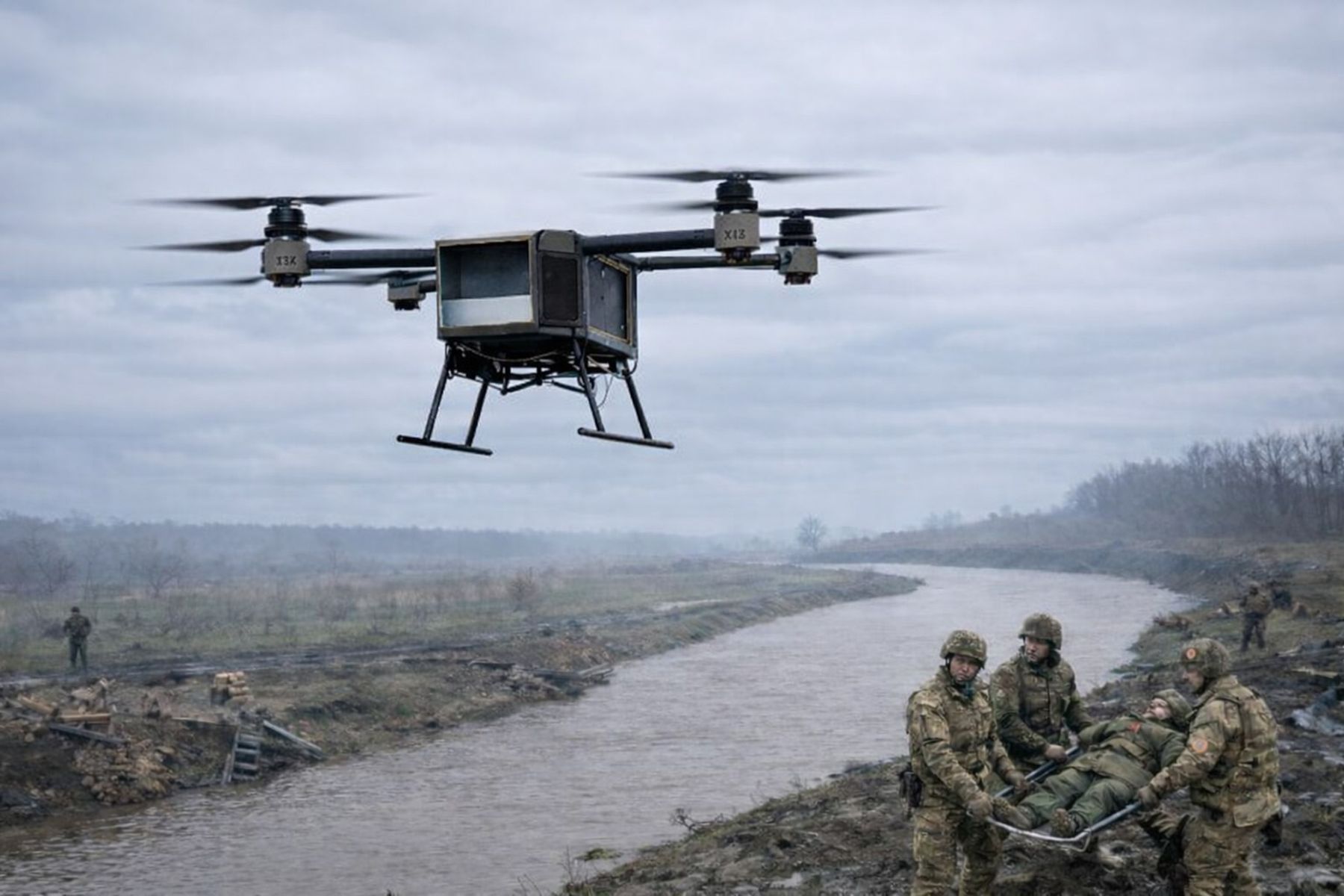
SPASOLIT heavy-lift octocopter flying over a frontline evacuation
Seed round open · TRL 4 achieved

Protect the skies. Save lives.

The first aerial multi-use platform engineered for air-launch counter-UAS interception, frontline resupply and casualty evacuation — on one modular 100+ kg airframe.

SPASOLIT /spah-so-leet/ — noun From Ukrainian спасо — to save · літ — to fly
$1M
Seed round
100+ kg
Payload
TRL 4
Achieved
No peer
Competitor at this scale
$5M
Series A path
Business opportunity

One platform, three critical gaps

SPASOLIT is an add-on tool engineered to solve critical mission needs through rapid, high-priority payload delivery — with the same airframe, van and crew serving air defense, logistics and medical missions.

Air-launch C-UAS carrier

A carrier drone armed with modular multi-launch pods, firing multiple interceptors at incoming aerial threats — then returning autonomously to reload.

Delivery of life-saving supplies

Sustainment, ammunition, batteries, comms and tools flown directly to units on or near the line of contact, without exposing a ground crew.

CASEVAC

Timely evacuation of wounded soldiers and civilians — and recovery of the fallen — from zones where sending a team puts more lives at risk.

The problem

Critical payload delivery is severely limited

01

Constantly increasing aerial threat requires higher density of C-UAS defenses

The mass deployment of Shahed-136/131 UAVs is rapidly depleting Ukraine's high-cost missile inventories, creating urgent demand for an additional network of highly manoeuvrable ground-based aerial launch interceptors.

02

Sustaining units near the line of contact is challenging, unreliable and inconsistent

Drone-enabled targeting and constrained manoeuvre routes make conventional movement increasingly dangerous, unreliable and unsustainable.

03

Modern combat conditions are severely limiting casualty evacuation and survival rates

Sending a team into a danger zone puts more lives at risk. Observations from Ukraine demonstrate a need to experiment with and invest in robotic, unmanned and autonomous ground and air systems dedicated to reliable delivery of life-saving supplies and timely evacuation of casualties.

The solution

A modular multi-use aerial delivery platform

SPASOLIT is a modular 3-in-1 platform for combined ground–air missions: a 4×4 off-road capable van operated by a two-person team, delivering a heavy-lift octocopter and its payload to a forward deployment location.

100+ kg
Payload capacity
10 min
Drone deployment
40 / 60 min
Flight time loaded / unloaded
15+ km
Operational range, one way
Module 01

The van

  • Equipped staging unit transports drone, payload and team to a forward launch position — the ground mission
  • Carries spare parts, battery chargers, comms and medical supply
  • Enables mobility and rapid repeated deployment across challenging terrain and contested environments
Module 02

Drone & cargo

  • Three drone sizes: SPASOLIT-Box, SPASOLIT-Slab, SPASOLIT-Mini
  • Three payload container sizes, optimised for end-user defined loads
  • Octocopter airframe: 100+ kg payload with 8-rotor redundancy
  • 40 min loaded / 60 min unloaded · 15+ km round trip range
Module 03

Team & SOPs

  • Two operators plus on-site technical and mission support
  • Tier 3 combat medic certification for all operators
  • Casualty receiving, transporting and off-loading protocols developed per end-user input
  • Remote troubleshooting support built into the SOP
Airframe family

Three airframes. One operating model.

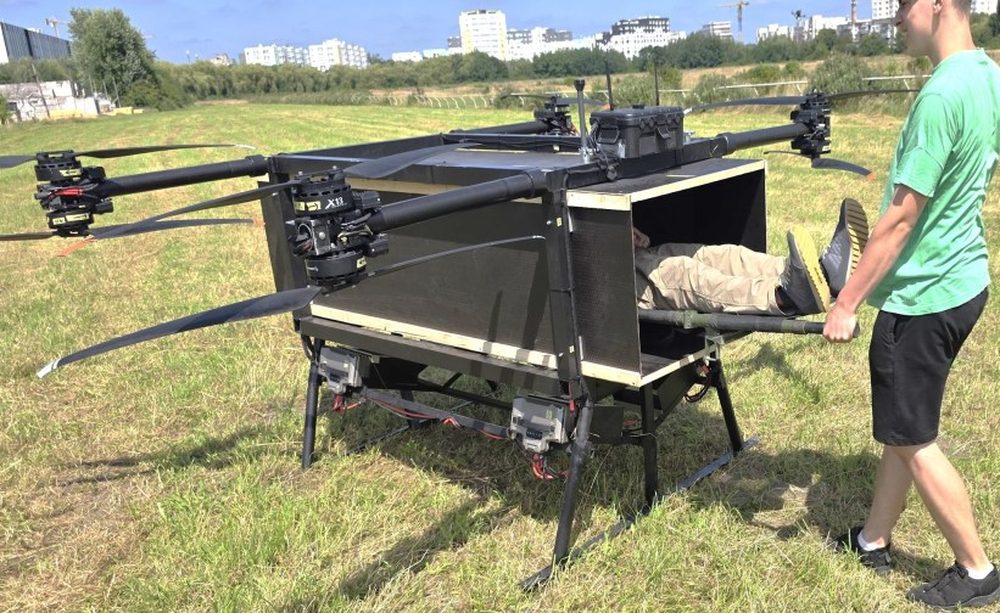
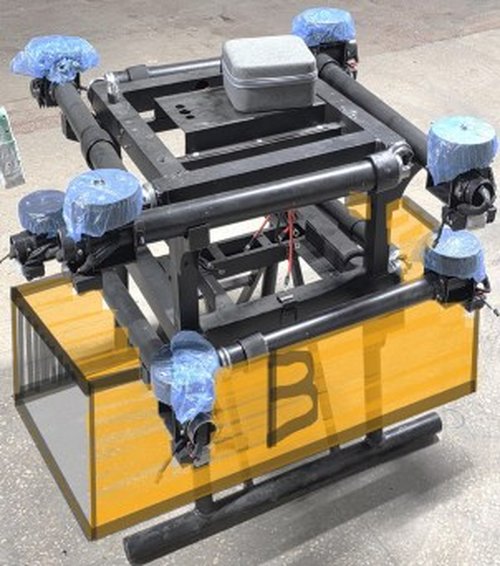
SPASOLIT-Box heavy-lift octocopter loading a casualty in the field

SPASOLIT-Box

Full enclosed cargo bay for the heaviest payloads and stretcher-borne CASEVAC. The reference configuration of the platform.

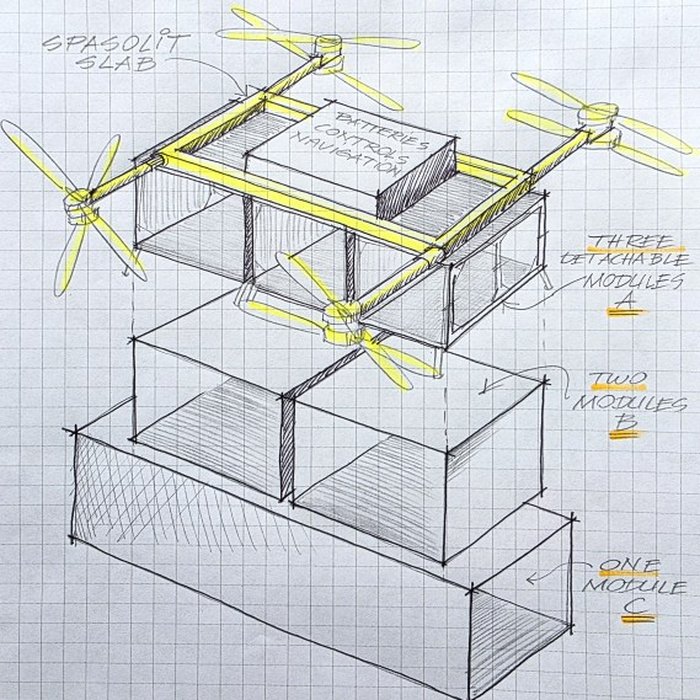
SPASOLIT-Slab design drawing with three detachable modules

SPASOLIT-Slab

Open flat-frame configuration with three detachable modules stacked under the airframe — fastest reconfiguration between mission types.

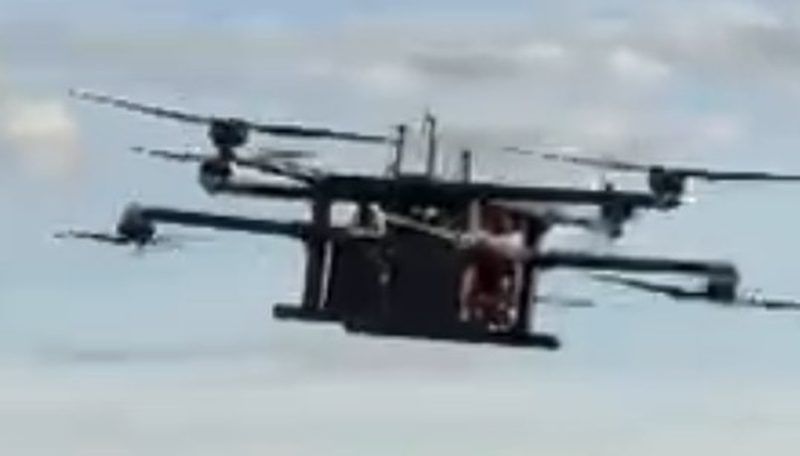
SPASOLIT-Mini light frame drone in flight

SPASOLIT-Mini

Light frame for ultra-fast supply drops and small-form CASEVAC tasks. Two minis fit in a single off-road 4×4 van.

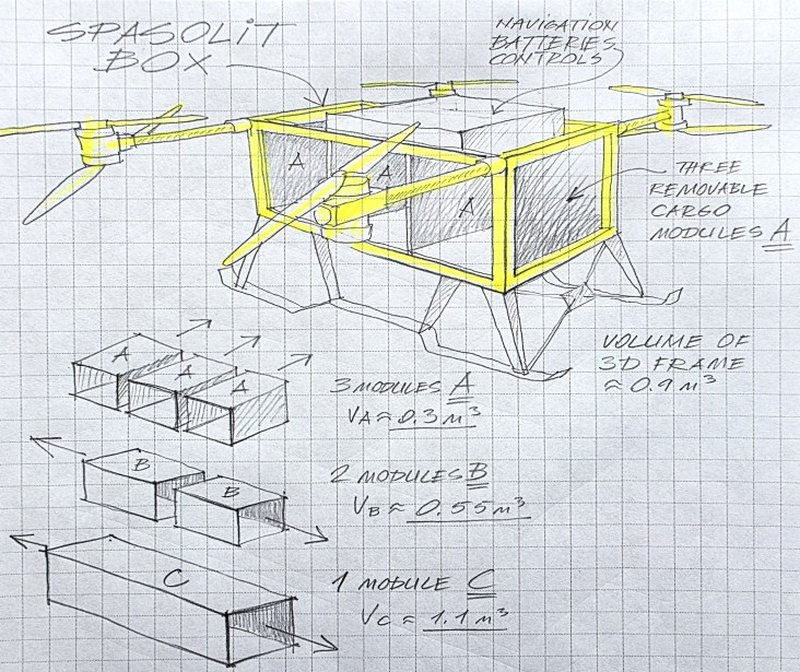
Three detachable cargo modules

Optimised for end-user defined payloads. Modules detach without tools, so the same airframe switches between air-defense, logistics and medical loads between sorties.

Module A
0.3 m³
3 × per airframe
Module B
0.55 m³
2 × per airframe
Module C
1.1 m³
1 × per airframe
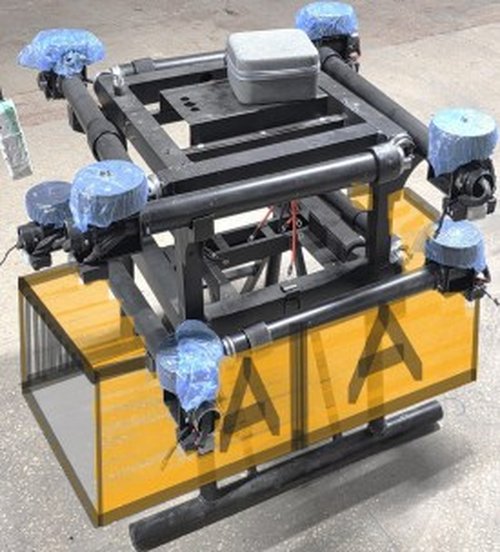
Module A cargo container hardware
Module A — production hardware
Module B cargo container hardware
Module B — production hardware
SPASOLIT-Box design drawing showing the three cargo module sizes
SPASOLIT-Box design drawing — cargo module geometry and volumes.

Ten minutes from arrival to airborne

A two-operator team unloads and deploys the drone with attached cargo modules in minutes. The team then remotely controls the flight, monitors landing and take-off, and manages cargo loading and unloading — keeping crews out of the danger zone.

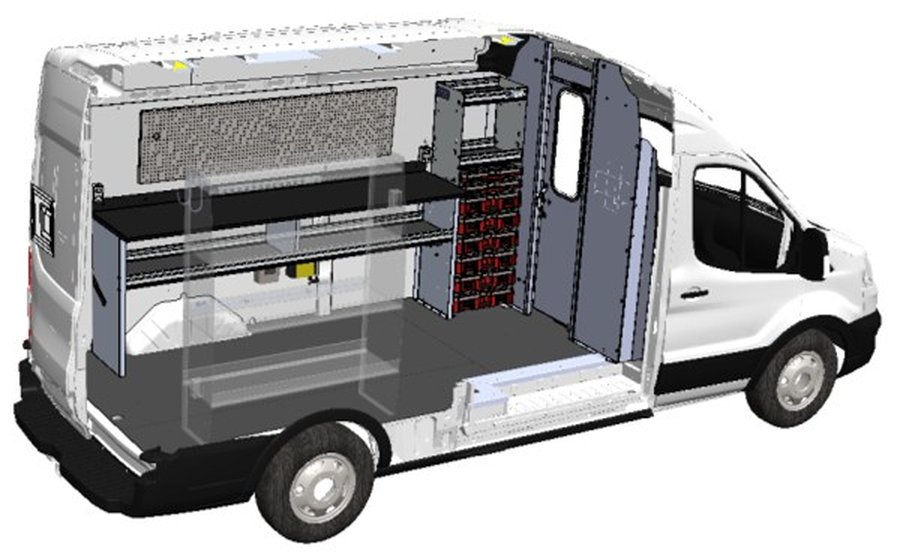
  • Off-road 4×4 van carries two SPASOLIT-Mini airframes plus modules
  • Detachable modules swap without tools between air-defense, logistics and medical loads
Cutaway render of the SPASOLIT off-road 4x4 van carrying two mini airframes
Off-road 4×4 van, equipped staging configuration with 2 × SPASOLIT-Mini.
Main use cases

Payload types the platform carries

Air defense

Air-launch multi-interceptor carrier

  • Counter-UAS aerial launch system firing multiple interceptor drones at aerial and ground targets
  • Air-lifting a fixed-wing and/or rotary drone for release from a specific altitude
  • Air-lifting special equipment to support communications — portable radar, repeaters, antennas
Logistics

Delivery of life-saving supplies

  • Sustainment — food, water, medicine, clothing, hygiene products, sleeping bags
  • Equipment — radios, fresh batteries and chargers, observation tools, antennas, Starlinks, gas stoves and fuel, generators
  • Tools — shovels, axes, nails, ropes, nets, plastic sheet and insulation
  • Ammunition and weapons
Medical

CASEVAC

  • Wounded soldiers
  • Wounded civilians
  • Bodies of fallen soldiers and civilians
  • All operators carry Tier 3 combat medic certification; receiving and off-loading protocols are built with end users
Market entry

Counter-drone aerial multi-launch capability

Semi-autonomous air-defense nodes positioned at distance to form a network — an additional asset protecting airspace already covered by pickup-based anti-Shahed teams and high-end air defense systems.

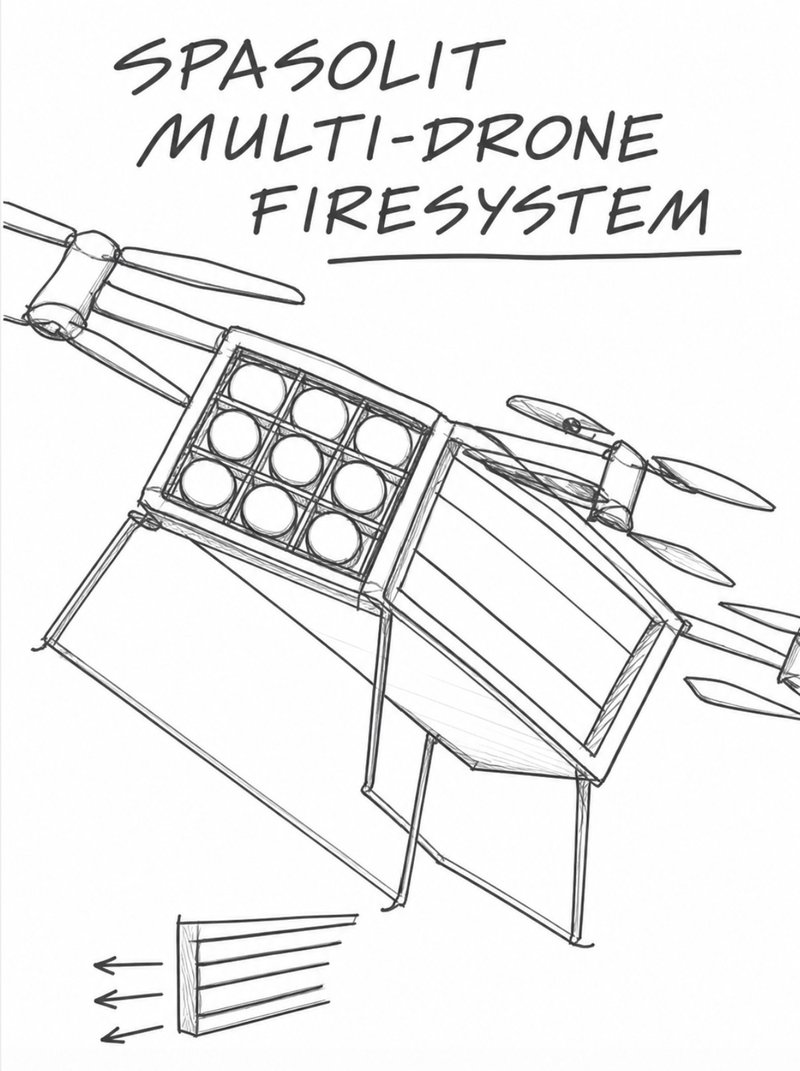
  • A less-trained crew of two delivers the node into a forward deployment position; once airborne, drones are flown by qualified pilots far from the launch point
  • Each carrier drone is equipped with modular multi-launch pods containing interceptor drones
  • After firing within engagement range, the carrier autonomously returns for rapid reload, container replacement or tactical repositioning

Swarm-capable enemy UAS threat requires a multiple, low-cost, mass-produced, rapid-fire aerial drone response.

SPASOLIT multi-drone firesystem concept drawing
SPASOLIT multi-drone firesystem — modular multi-launch pod concept.
Market timing

“Drone-as-a-service” has crossed from experiment to doctrine

Military decision-maker buy-in

Command-level understanding of unconventional logistics and rescue solutions has shifted from skepticism to urgency.

Drone technology maturity

Ukraine's war for survival has created a unique innovation ecosystem — the densest applied aerial drone R&D environment in the world.

Active demand in Ukraine

UAF and civilian defense face growing payload and CASEVAC shortfalls. Continuous aerial attacks demand increased air defense capabilities.

Minister of Defense of Ukraine · 18 April 2026
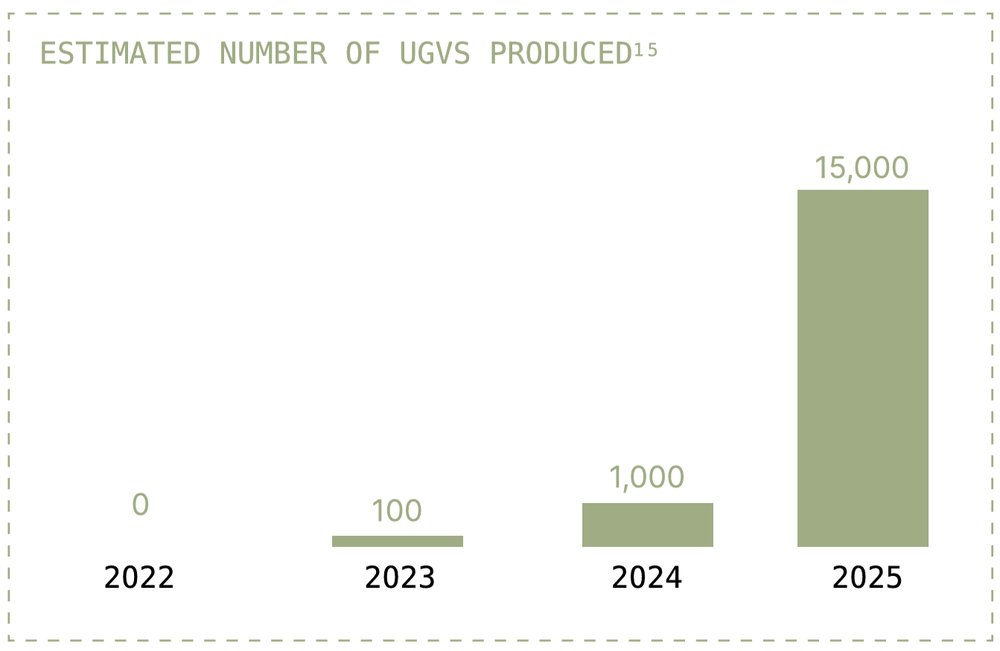
  • 9,000+ Unmanned Ground Vehicle missions completed in March 2026 alone
  • The stated goal is for 100% of frontline logistics to be handled by robotic systems
  • In H1 2026 the Ministry of Defense intends to contract 25,000 UGVs — twice as many as in all of 2025
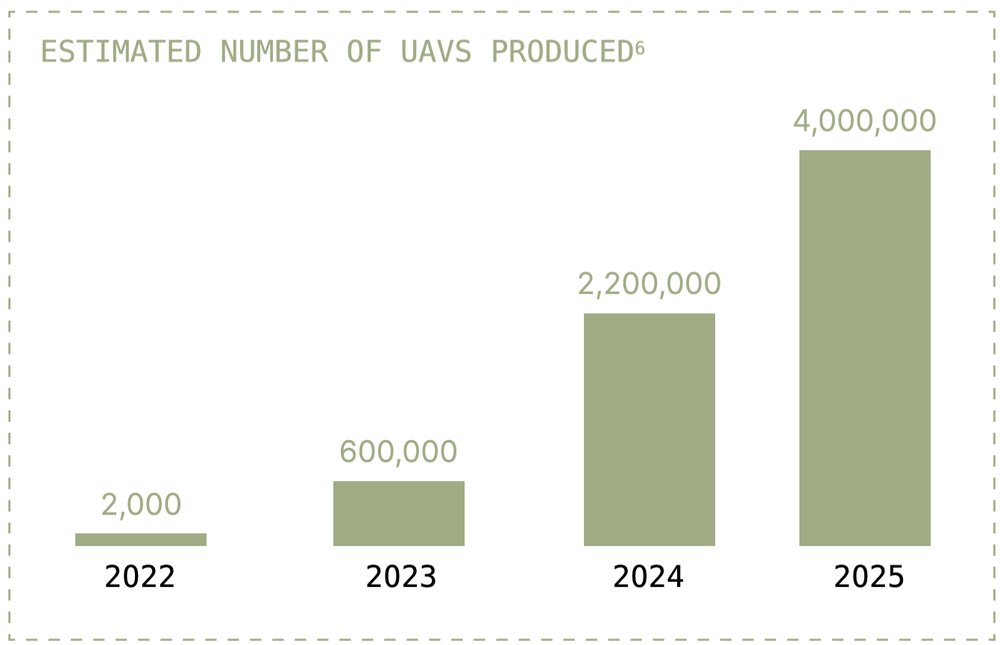
Estimated number of UAVs produced in Ukraine, 2022-2025
Estimated UAV production. Data courtesy Snake Island Institute.
Estimated number of UGVs produced in Ukraine, 2022-2025
Estimated UGV production. Data courtesy Snake Island Institute.
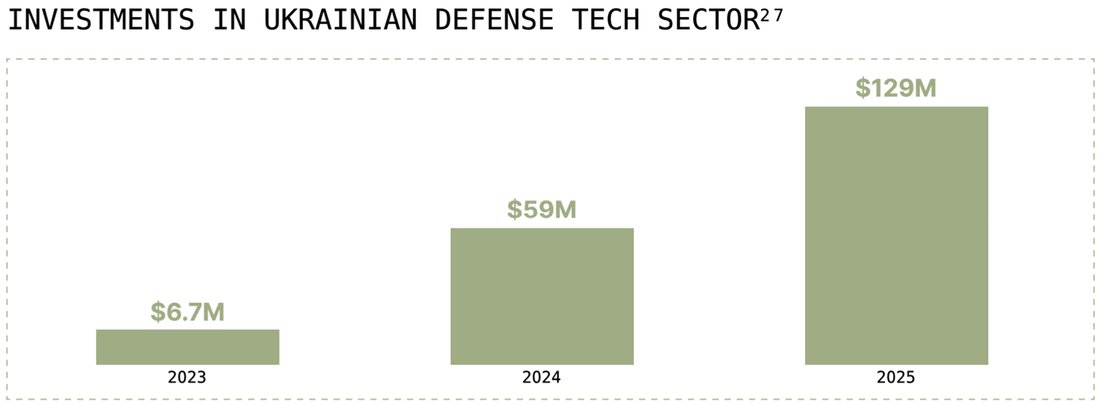
Investments in the Ukrainian defense tech sector
Investment into Ukrainian defense tech. Data courtesy Snake Island Institute.
Demand

High demand for multi-use solutions

Military / Defense

Procurement traction with primes such as:

  • Ukraine Armed Forces (immediate)
  • NATO member states
  • Allied military, border guard and air defense forces

Civilian / Emergency

Multi-use and modularity should be attractive to:

  • Search & rescue teams
  • Rapid supply and relief delivery NGOs
  • Remote medical services and CASEVAC
  • Humanitarian missions and commercial property protection

First-mover window open

No comparable platform exists at this scale, price point or deployment model. Category leadership is unclaimed.

Allied NATO demand

30+ NATO member states express growing interest in affordable, field-deployable, multi-use payload delivery solutions.

Clear codification path

Ukraine MoD codification is a step towards NATO certification, developed to lower procurement barriers for allied and friendly forces.

Channel economics

Project profit assumptions: government vs commercial

Defense contract through MoD
$12.6M
total profit · 25% margin cap · regulatory ceiling
$340K
$1.00M
$1.88M
$9.38M
S1
15 units
S2
50 units
S3
100 units
S4 — Scale-up
500 units

Floor case — capped pricing, predictable buyer.

2.2×
Commercial direct
$27.7M
total profit · 55% margin · market-driven
$740K
$2.20M
$4.13M
$20.6M
S1
15 units
S2
50 units
S3
100 units
S4 — Scale-up
500 units

Upside case — same product, 2.2× the profit.

The model includes direct cost + overhead. Excludes profit from service, deductions from taxes and fees.

Key milestones

From proof of concept to full-scale manufacturing

Q1–Q3 '25 · Phases 1–2

Proof of conceptComplete

Lift, land, manoeuvre, navigate and control verified in field testing. TRL 4 achieved.

Q3 '26 · Phase 3

Seed investment — $1MOpen now

The round that funds prototypes, codification and the team build-out described below.

Q3–Q4 '26 · Phase 3 · TRL 5–6

Build minimum 5 prototypes

8 drones + 5 vans delivered to selected units for field R&D — finishing R&D and completing field testing.

Q3–Q4 '26 · Phase 4 · TRL 7

Codification by the MoD of Ukraine

Assignment of a unique NATO Stock Number (NSN) and registration in Ukrainian and NATO databases.

Q4 '26 · Phase 5

First production run

20 drones + 15 vans produced at cost.

Q4 '26 · Phase 5

Series A investment — $5MPlanned

Capital to move from first production run into full-scale manufacturing.

Q1–Q2 '27 · Phase 6 · TRL 8

Full-scale manufacturing

Ready to scale to 50+ drones and 40+ vans.
Investment opportunity
The ask Seed $1M
8 units MoD codification Team build-out
Use of $1M seed funds
Hardware & Manufacturing
65%
Team Build-Out
20%
Legal, IP & Professional
7%
NATO Cert & Codification
2.7%
Unforeseen expenses, allowance
2.3%
R&D & Field Testing
1.65%
SOP Development & Training
1%
Request the full deck Email the CEO
Executive team

Leadership

Yuriy Nyzhnykevych, Founder and CEO

Yuriy Nyzhnykevych

Founder & CEO
  • Original idea; closed initial R&D funding
  • Built and flight-tested the proof-of-concept
  • Direct relationships with military and medical units in Ukraine
  • Led concept-to-TRL4 with a feedback loop from units; leads US and Ukraine teams
Olena Nyzhnykevych, Chief Business Development Officer

Olena Nyzhnykevych

Chief Business Development Officer
  • Strategic leader in international business development
  • Investor relations and fundraising with deep experience in the US and Ukraine
  • Spearheading the seed round to scale production and accelerate deployment to the frontlines
Stefan Szkwarek, Aerospace Engineering Advisor

Stefan Szkwarek

Aerospace Engineering Advisor
  • Over two decades as an Aerospace Engineering Officer with the Royal Canadian Air Force
  • Former site manager for the Fixed-Wing Search and Rescue Training Centre
  • Mechanical engineering degree, Royal Military College of Canada; MSc in aerospace vehicle design, Cranfield University
Myron Rabij, Legal Counsel

Myron Rabij

Legal Counsel
  • Contact partner at Davidoff Hutcher & Citron LLC, specializing in M&A, joint ventures, project finance and cross-border transactions
  • Advises international clients on acquisitions, capital raises, governance, compliance and regulatory matters
  • Deep expertise in Eastern European energy and venture technology sectors
Luke Fitch, Heavy Lift Drone Expert

Luke Fitch

Heavy Lift Drone Expert
  • Pioneering designer and builder of custom heavy-lift UAVs for cinematic and tactical use since 2011
  • Delivered recon and bomber drones for frontline units
  • 16 deployments to Ukraine; certified in rapid prototyping, Ukrainian Military Intelligence (HUR)
Get in touch

Let's build the future of
aerial payload deliveries together.

Investor introductions welcome. We are raising a $1M seed round to reach MoD codification and a first production run.

Yuriy Nyzhnykevych

Founder & CEO, SPASOLIT Group Inc.
+1 (206) 291-0582 WhatsApp / Signal
Request the investor deck
© 2026 SPASOLIT Group Inc. All rights reserved.
Investor presentation · Non-confidential